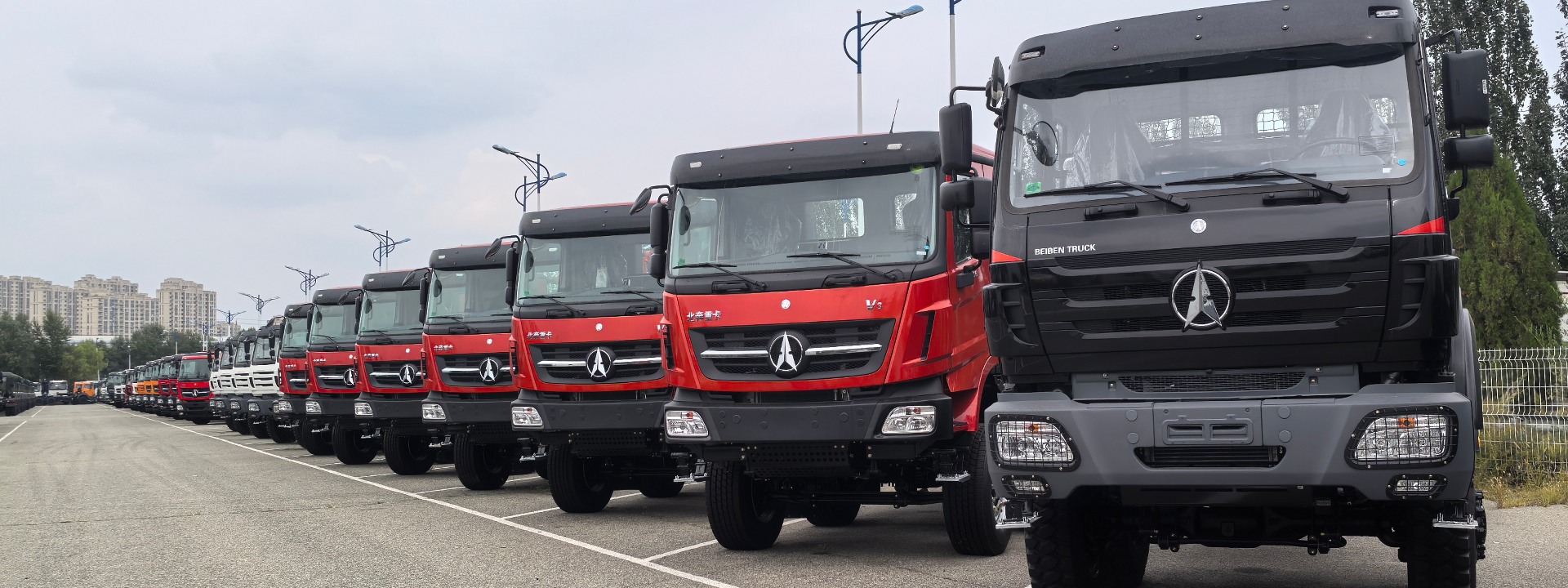
Camion-grue Beiben
Le Beiben 6×6 camion équipé d'une grue articulée, construit sur un châssis tout-terrain à transmission intégrale, permet des opérations de levage et de transport dans des conditions de terrain complexes. Il est largement utilisé dans le sauvetage technique d'urgence et la manutention de matériaux sur le terrain. Des pratiques d'exploitation normalisées et un entretien systématique permettent non seulement d'éviter les risques de sécurité, mais aussi de prolonger la durée de vie du véhicule complet et de la grue. Cet article présente les points essentiels de l'exploitation et les spécifications de maintenance pour aider à maintenir les performances stables de l'équipement et réduire les pannes imprévues.
1. Présentation du camion-grue articulée Beiben 6×6
Le camion-grue articulée Beiben 6×6 se compose d'un châssis tout-terrain à transmission intégrale et d'une grue articulée. Le châssis adopte la cabine large NG80, équipée d'un moteur Weichai et d'une transmission Fast. Avec une transmission intégrale à trois essieux et des pneus tout-terrain 14.00R20, il offre une excellente capacité de franchissement et d'auto-récupération sur des surfaces non pavées telles que les sols boueux, les terrains enneigés et les sous-sols meubles. Son cadre adopte la structure à section transversale variable en ventre de poisson issue de la technologie Mercedes Benz avec une rigidité torsionnelle élevée, jetant une base stable pour les opérations de levage de charges lourdes.

|
Châssis |
Beiben NG80B 6×6 |
|
Moteur |
WP12.420E32, 420 ch |
|
Transmission |
FAST 12 vitesses |
|
Essieu avant/arrière |
7000 kg / 13000 kg |
|
Boîte de transfert |
LF200 |
|
Pneus |
14.00R20, 6+1 pièces |

|
Spécifications de la grue |
|
|
Modèle de grue |
Modèle de grue |
|
Capacité de levage maximale |
Capacité de levage maximale |
|
Moment de levage maximal |
Moment de levage maximal |
|
Portée maximale |
Portée maximale |
|
Hauteur de levage maximale |
Hauteur de levage maximale |
|
Rayon de travail de la grue |
Rayon de travail de la grue |
|
Angle d'orientation |
Angle d'orientation |
|
Écartement des stabilisateurs |
Écartement des stabilisateurs |
2. Comment utiliser le camion-grue articulée Beiben 6×6
 |
 |
3. Calendrier de maintenance
| Intervalle de maintenance | Opérations de maintenance |
| Toutes les 50 heures | • Vérifier l'absence de fuites au niveau des raccords du système et des vérins |
| • Vérifier le serrage des boulons de montage | |
| Toutes les 450 heures ou tous les 6 mois | • Graisser l'unité d'orientation de la colonne |
| • Graisser les points d'articulation | |
| • Graisser la flèche télescopique | |
| • Graisser la tige de piston sortant du vérin | |
| • Vérifier l'usure des patins de glissement ; remplacer s'ils sont usés | |
| • Remplacer le filtre à huile hydraulique et le filtre reniflard d'air | |
| • Vérifier l'usure du câble et le remplacer à temps | |
| Toutes les 900 heures ou une fois par an | • Tester les vérins hydrauliques |
| • Vérifier le serrage de la vis de base | |
| • Vérifier les réglages du système hydraulique et l'efficacité des dispositifs de sécurité | |
| • Vérifier le serrage de la vis de la grue | |
| • Vérifier la structure de la grue | |
| • Vérifier/remplacer les vis de réglage et les patins de glissement | |
| • Remplacer l'huile |
4. Analyse et élimination des pannes générales
| Pannes | Cause | Élimination |
| Vibrations dans le vérin de la grue ; saccades lors de l'extension de la flèche pendant la manœuvre initiale | 1. Présence d'air dans le système hydraulique | 1. Purger l'air par le mouvement |
| 2. Joints de vérin usés | 2. Remplacer les joints de vérin | |
| 3. Saleté dans la soupape d'équilibrage | 3. Nettoyer la soupape d'équilibrage | |
| Ralentissement de tous les mouvements, même sans charge sur le crochet | 1. Tuyau d'aspiration écrasé ou bosselé. | 1. Remplacer le tuyau d'aspiration |
| 2. Aspiration d'air | 2. Resserrer le joint du tuyau d'aspiration | |
| L'extension de la flèche ne s'ouvre pas en séquence. | 1. Manque de lubrification | 1. Graisser |
| 2. Patins de glissement usés | 2. Remplacer les patins de glissement | |
| 3. Réglages incorrects de la soupape d'extension de la flèche | 3. Régler la soupape | |
| La grue ne soulève pas la charge nominale. | 1. Pompe inefficace | 1. Remplacer la pompe |
| 2. Réglages incorrects de la soupape de décharge | 2. Régler la soupape | |
| 3. Joints de pompe hydraulique usés | 3. Remplacer les joints de la pompe | |
| La flèche descend automatiquement avec la charge levée | 1. Joints de tige de piston du vérin de relevage usés | 1. Remplacer les joints du vérin |
| 2. L'orifice de la soupape d'équilibrage est obstrué ou le ressort de rappel est usé. | 2. Nettoyer la soupape d'équilibrage et remplacer le ressort | |
| La grue ne peut pas pivoter avec précision | 1. Dépassement de la pente maximale du camion | 1. Rétablir le camion dans la marge d'erreur acceptée |
| 2. Obstruction dans la soupape tampon | 2. Nettoyer ou remplacer la soupape tampon de pivotement | |
| 3. Joints du vérin de pivotement usés | 3. Remplacer les joints | |
| 4. Butée interne de la colonne d'engrenage usée | 4. Remplacer la butée | |
| Bruit au niveau des joints ou des pièces de pivotement | Manque de lubrification | Graisser aux intervalles spécifiés |
| Le vérin de la jambe de stabilisation ne peut pas supporter la charge | 1. Double soupape inefficace | 1. Nettoyer ou remplacer la soupape |
| 2. Joints de tige de piston du vérin de jambe usés | 2. Remplacer les joints | |
| Fuite d'huile du vérin | 1. Joints usés | Remplacer les joints |
| 2. Bague d'étanchéité du piston usée | ||
| Bruit et fluctuations de pression importants, sifflement de la soupape hydraulique. | 1. Tuyau d'aspiration ou crépine d'aspiration obstrués | 1. Éliminer la saleté |
| 2. La viscosité de l'huile est élevée | 2. Remplacez l'huile ou réchauffez-la | |
| 3. Mauvais joint pour l'orifice d'aspiration et de l'air est aspiré | 3. Remplacez les joints et serrez le boulon | |
| 4. Les pièces de la pompe sont usées | 4. Remplacez ou entretenez les pièces internes | |
| 5. La pression du système est élevée | 5. Ajustez la pression du système |
 |
 |
5. FAQ
Q1 : Comment choisir entre une grue à flèche articulée et une grue à flèche télescopique ?
La grue à flèche articulée peut être repliée. Elle n'occupe aucun espace dans la caisse de chargement lorsqu'elle est rangée, ce qui la rend adaptée aux conditions de travail nécessitant un levage et un transport intégrés ainsi qu'aux opérations dans des espaces confinés. Une grue à flèche télescopique offre une plus grande longueur de flèche et une efficacité de levage supérieure, idéale pour le levage en point fixe sur des sites en plein air.
Q2 : À quelle fréquence l'huile hydraulique doit-elle être remplacée ?
Pour un équipement neuf, le premier entretien a généralement lieu après environ 500 heures de fonctionnement ou 3 mois, selon la première éventualité. Un remplacement ultérieur est requis toutes les 1000 heures de fonctionnement ou tous les ans. Suivez toujours le manuel du fabricant de la grue pour les spécifications exactes.
Q3 : Quels certificats sont requis pour l'utilisation ?
Conformément à la réglementation, les opérateurs doivent être titulaires d'un certificat d'opérateur d'équipement spécial pour les opérations de levage. Suivez la formation fournie par le fabricant et familiarisez-vous avec le limiteur de moment de charge avant de prendre vos fonctions.
Q4 : Le levage est-il autorisé dans des conditions météorologiques difficiles ?
Arrêtez toutes les opérations de levage en cas de vent de force 6 ou plus, d'orages ou de brouillard épais. Pour les opérations sur site enneigé, faites attention aux mesures antidérapantes des stabilisateurs et à la capacité portante du sol.

 IPv6 réseau pris en charge


 français
 English
 русский
 español
 العربية
 S'abonner